Why I couldn't build Jev at OpenAI — Diogo Almeida
Diogo Almeida · TypeSafe
Decide API live — jv_live_ keys, try free
Jev is TypeSafe's System One model. It returns typed judgments for classification, routing, and scoring. Your code combines those judgments with business rules, authorization, and review before taking action.
Independent third-party host, not TypeSafe official. Try the existing playground, then use this host's jv_live_ keys and prepaid packs from $5.
Free: 5 runs without signup · 10,000 tokens/month on signup · 3 People Search lookups
Live example
A real support message — several typed decisions in one call.
sample · edit & run for live API
Community explainers
From browser agents to routers and serving — the decision layer plugs in without replacing your generative models.
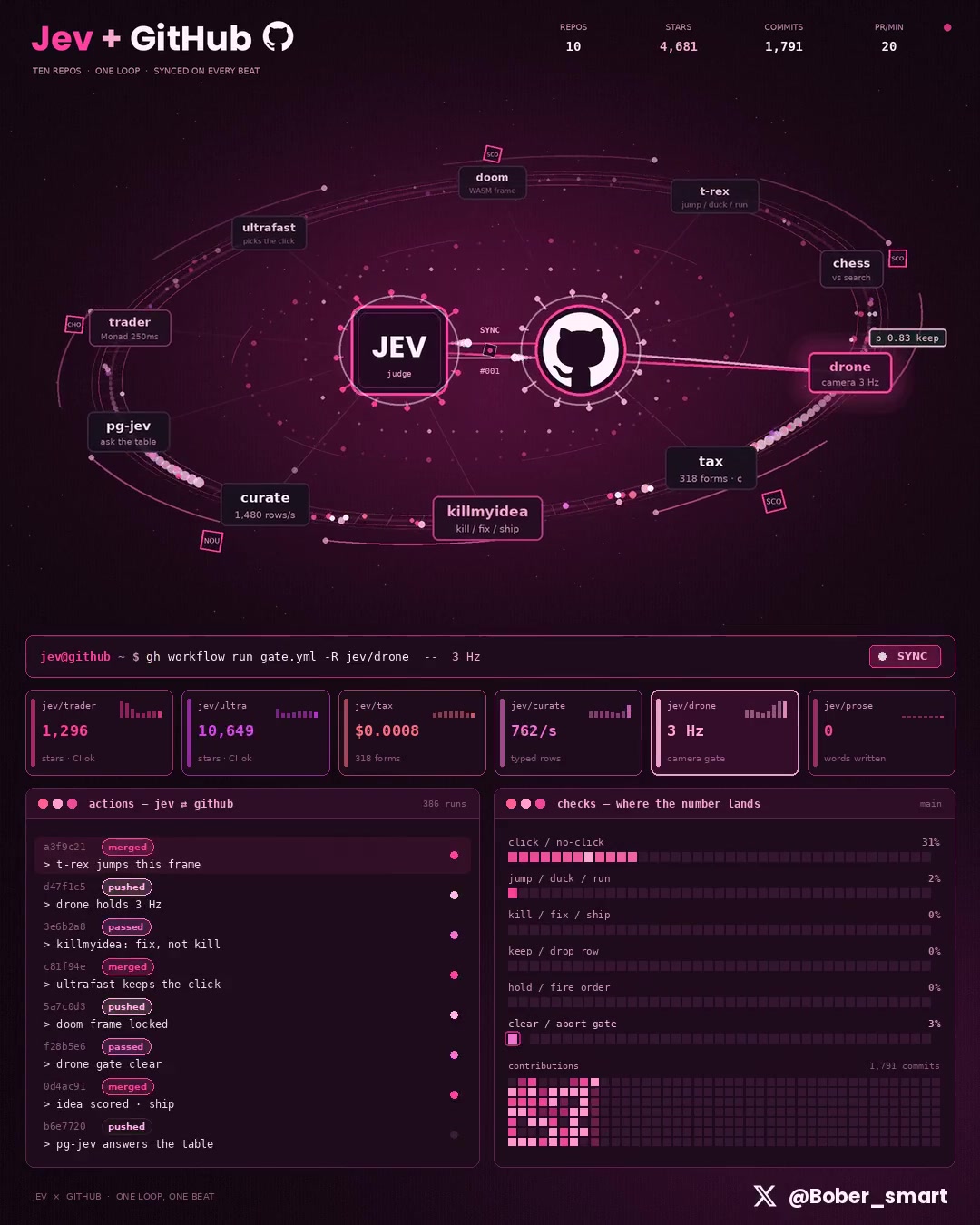
Run a live decide below — including a zero-token Image / Box beta preview and game previews — then open the full Jev Playground for production templates (5 free anonymous runs). After a run you like, copy the same pattern into the API.
Jev Workbench
Pick a scenario, tweak the input, run the real API — then copy the pattern into your app.
Local preview · jev-snake (no API / $0)
Live preview · local heuristic
$0 · no tokensmoves
0
last
—
length
3
Auto-playing with a local heuristic so the homepage stays free. The full game page uses real decide calls (rate-limited demo).
Decision stream
preview · not billed
Jev Snake
* Simulated latency for the preview. Full page = real API round-trip.
Open full Snake demo →Jev is TypeSafe's System One model for focused questions about supplied state. Choice selects a label and returns a distribution and confidence. Score returns a value on an ordered rubric, with a distribution and confidence. Noul returns a probability from 0 to 1 for a yes/no question. These outputs are inputs to application logic, not guarantees that a business action is correct. This website is an independent third-party host with its own accounts, prepaid balance, and keys (not affiliated with TypeSafe AI). Try the playground free, then ship with prepaid jv_live_ keys against /api/v1/decide. Official TypeSafe endpoints and keys are separate from this host's API.
TypeSafe explains the division between model judgments and application decisions in Don't Call It a Decision Model.
Deeper explainer: System One model · FAQ · API docs
Ask whether a message requests a refund. Let code check eligibility, compare the amount with a policy limit, and route it for authorized review. Do not hide all those rules inside one broad question about what to do.
Read the judgment-and-code methodOpen the existing playground
Jev’s three primitives — typed judgments your agent code can combine with rules, not chat strings.
Choice
Pick one label from a closed set — route, allow/block, escalate — with a distribution and confidence.
Score
Ordered scale for urgency, risk, or quality your code can threshold — with a distribution and confidence.
Noul
Probability from 0 to 1 for a yes/no question — not a separate confidence field.
Bounded judgments your code can combine with rules — not another chat window.
Support Triage
Automatically classify, prioritize and route support tickets.
Agent Safety
Detect risky actions before an AI agent acts.
Content Moderation
Classify content into allow / review / block.
Lead Scoring
Score inbound leads and route high-value prospects.
RAG Relevance
Decide whether retrieved documents are relevant.
LLM Routing
Choose the cheapest model capable of handling a request.
Free anonymous trial (5 runs) → prepaid packs from $5 (≈ 11.9M input tokens) → production balance. Input metered; output free on this host. Retail band about $0.175–$0.42/M.
This is an unofficial community resource. We are not affiliated with TypeSafe AI.
Jev supplies typed judgments over the state you provide. Application code owns rules and actions. Prefer typed judgments for application logic over treating model output as permission to act.
This unofficial host issues instant jv_live_ keys and meters prepaid capacity for /api/v1/decide, /api/v1/batch/decide, a free /api/v1/gate, and ready-made product paths. Upstream keys stay on our servers. Generative models can supply text or deeper reasoning when a workflow needs them — neither model output bypasses your authorization checks.
Source reference: Don't Call It a Decision Model (TypeSafe, Nov 3, 2026). System One intro.
This is an unofficial community resource. We are not affiliated with TypeSafe AI. Instant jv_live_ keys, prepaid metering, playground and batch tooling. Upstream model access stays on our servers. See Terms, Privacy, and FAQ.
Short explainers for What is Jev AI?, how to use it, and what you can build. Play on this page (needs YouTube access).
Diogo Almeida · TypeSafe
Greg Isenberg
Hands-on review
The Code Report
Application rules and actions remain outside the model.
Published experiments use different versions, datasets, network conditions, and billing channels. They are not measurements of this host. Read the sources and methods on the benchmarks page before using a result in a production budget.
Six visual cards covering the talking points that show up again and again in public Jev intros: typed judgments instead of chat text, smart if-style routing, Choice / Score / Noul, parallel questions, calibrated confidence, and schema-safe outputs.
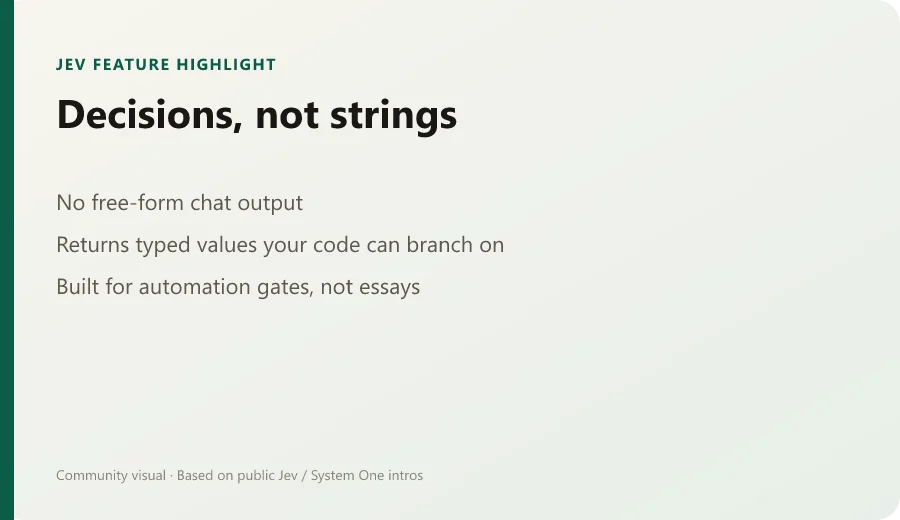
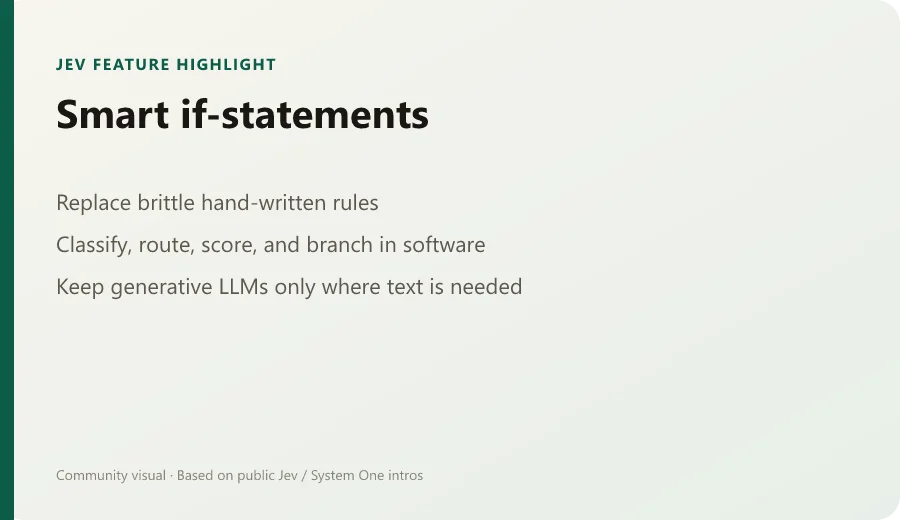
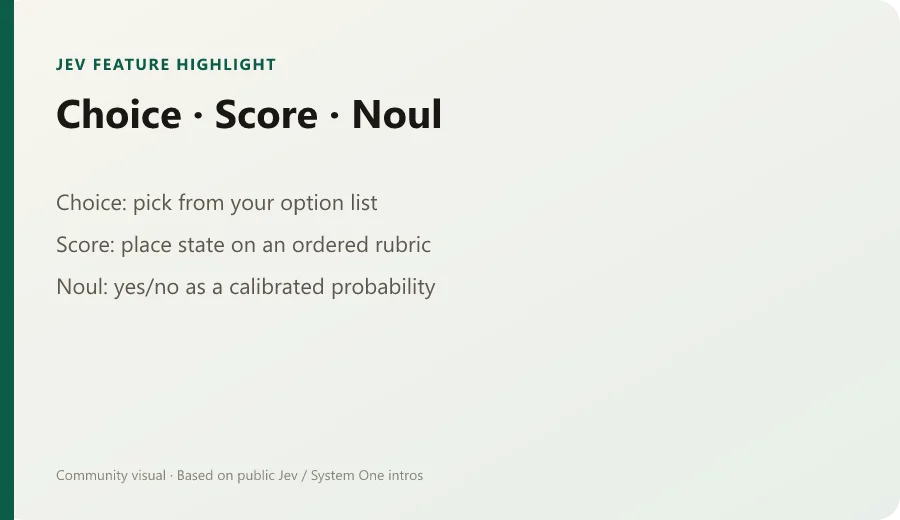
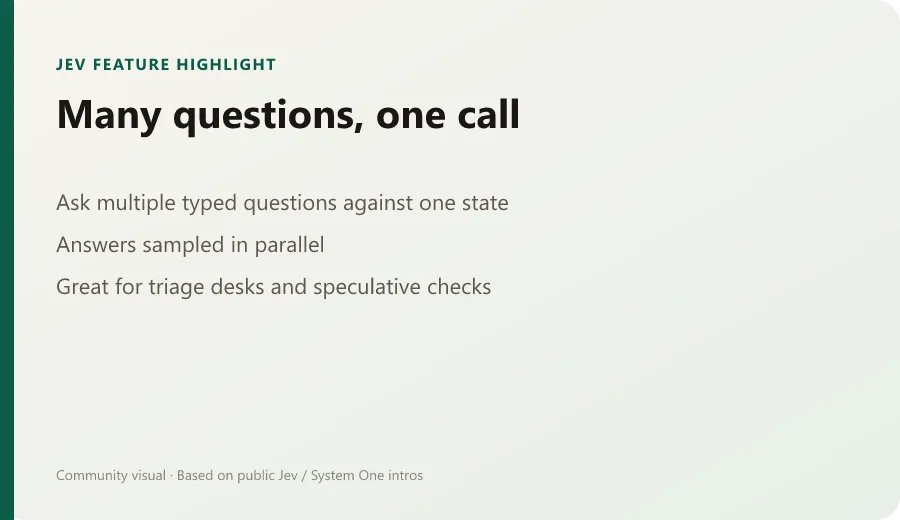
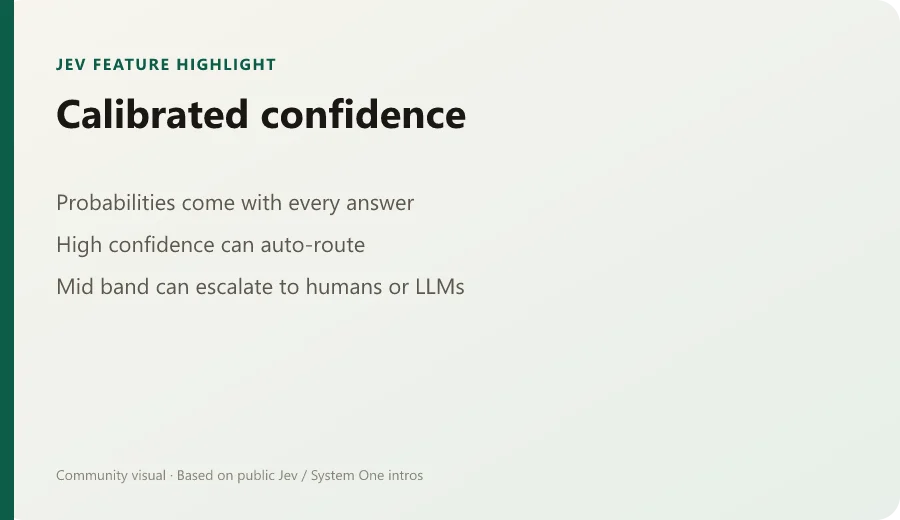
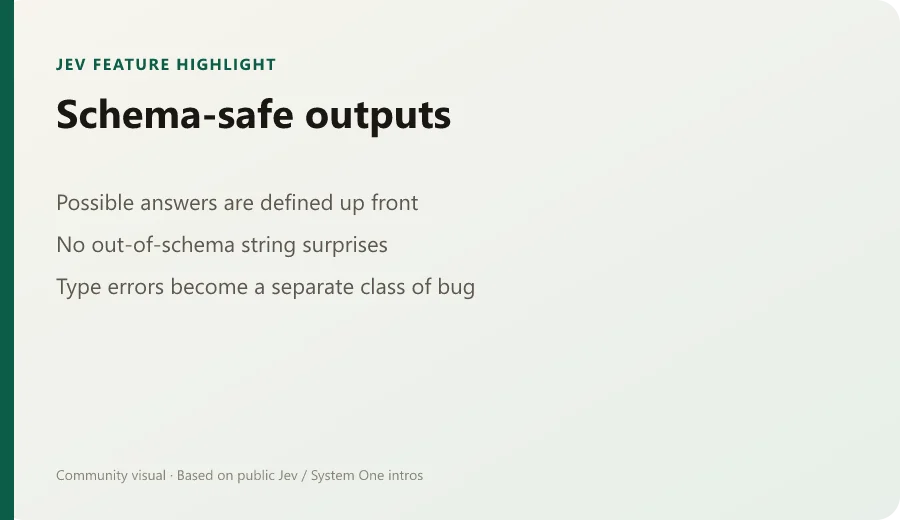
The System One / System Two naming comes from behavioral psychology. In agent engineering terms, the split maps cleanly to two different jobs inside one pipeline. See the glossary for short definitions.
Production stacks rarely pick only one. Most teams use Jev for focused judgments, then call a generative model only when the path needs prose, tool planning, or deeper reasoning. Read the comparison page for a feature-by-feature breakdown.
Demo → copy API → signup → prepaid key. 15 use-case guides and a live playground are ready now.
People SearchTutorialExamplesTypeScriptPythonCost calculatorJev vs GPT
Prepaid retail facts from this host's billing config. For attributed third-party latency and quality reports, open the benchmarks page.
Input pricing
≤ $0.42/M
This host retail packs; output free under metering
Free trial
5 runs
Anonymous real-API tool runs, no signup
Monthly grant
10,000
Input tokens for signed-in accounts
Starter pack
$5
≈ 11.9M input tokens
Third-party evidence
Attributed
Versions, samples, and limits — benchmarks